
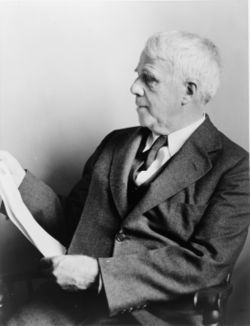
로버트 프로스트
출생:1874년 3월 26일
미국, 캘리포니아주, 샌프란시스코
사망:1963년 1월 29일
국적; 미국인
직업:시인
로버트 프로스트(Robert Frost, 1874년 3월 26일 ~ 1963년 1월 29일)는 미국의 시인. 뉴햄프셔의 농장에서 오랫동안 생활한 시인.
아름다운 자연의 현상을 쉬운 언어로 표현.
자연과 인간의 삶을 관계를 관조적 관찰로 상징적인 의미를 찾는 자연 친화적 시인,
20세기 미국 최고의 국민 시인, 전후 4회에 걸쳐 퓰리처상을 받음.
Dust of snow
Robert Frost
The way of crow
Shook down on me
The dust of Snow
From a hemlock tree
Has given my heart
A change of mood
And saved some part
Of a day I had rued
눈가루
로버트 프로스트(1874~1964)
까마귀 한 마리가
솔나무 위에서 가지를 흔들어
눈가루를
내 머리 위로 흩뿌리니
감정 상했던 내 마음을
오히려,
나아지는 변화로 되살려내네
의역: 권오은 시인
시 해설
어느 눈이 내린 날 솔나무 아래에 서 있는 나를 까마귀 한 마리가 날아와 나뭇가지 앉으니 눈가루가 내 머리 위에 떨어지자 정신이 번쩍 들었다.
일반적으로 사람들은 까마귀란 새는 유독 죽음과 공포, 그리고 부정적인 의미를 상징하는 새로 여긴다. 그런 까마귀가 눈을 피해 솔나무 아래에 서 있는 시인에게 눈이 쌓인 나뭇가지에 날아와 앉으니 가지가 흔들려 가지에 쌓인 눈가루를 흩뿌린다. 화가 날만도 하다. 부정의 색채와 눈가루(먼지)를 얻은 자신이 화가 날만도 한데 곧바로 자신의 마음을 위로로 전환한다.
이것이 이 시인의 관조적 통찰력이다. 눈가루(dust), 죽음, 검은색에 대한 공포에 대한 부정적인 색상 검은색 역시 긍정적인 흰색을 거쳐 나쁜 기운의 생각을 후회하면서 긍정의 뇌로 전환시킨다. 여기서 눈가루를 한갓 먼지로 표현한 것도 의도적인 부정적 감정을 극도의 순간 긍정의 역치적 전환의 기법이 탁월하다는 것과 타고난 관조적 통찰력은 그의 타고난 재능이 아닐 수 없다.
뿐만아니라, 시인은 부정을 극적인 긍정적으로 바꾸는 그 탁월한 재능이 바로 독자들을 더 감동 시키게 되는데, 비록 눈을 맞은 원인이 까마귀가 가지에 내려앉아서가 아니라 오히려 눈이 내 머리 위에 내려앉게 한 그 까마귀가 나를 정신이 번쩍 들게 하여, 우울하고 부정적 생각을 새로운 기분으로 되살아나게 해준 것이라고 반전하며 자신을 위로한다.
인생의 삶에서는 이유 없는 일은 없다. 만물의 하나하나는 다 이유가 있다. 좋은 것과 나쁜 것, 순리는 억지가 없으며 순리를 역행하지 않는다. 특히 자연은 더욱 그렇다. 자연은 질투를 하지 않는다. 있는 그대로 진실이기 때문이다. 시인은 이미 이런 현상에 대하여 통달한 것 같다. 시인의 글 대다수가 자연과 인간에 대한 주제가 많은 이유이기도 한 듯하다. 자연의 활동적 생명으로도 위로로 전환하는 그 탁월한 기법은 삶을 살아가는데 크나큰 교훈을 얻게 한다.
작은 부정의 생각이 화를 만들고, 적은 도움의 사상이 뇌를 커다란 선의적 행동의 변화로 활성화된다는 경험도 알고 있다는 메시지의 영감을 던진 시이기에 좋은 시로 추천한 것이다.
긍정적 사고는 학습과 경험에서만 있는 것이 아니다. 시를 통해 얻는 간접적 경험도 크게 기여한다는 것의 사실에 나를 더 아름답게 가꾸는 삶의 영양분이기 때문에, 남은 인생에 마지막 좋은 결과의 열메을 얻는 근본적 가치를 알게한 시이기도 하다.
문학의 장르 선텍은 매우 중요하다. 그 선택과 집중에 따라 시인의 꿈이 현실이 되기도 한다.
이 짧은 시 한 수를 통해서 타고난 나쁜 성질이 긍정적인 사고의 성격화 된 뇌로 전환 시킴의 영양가 되었으면 한다.
이 시 한 수를 통한 우리들의 감정의 뇌를 소재를 대치 헤 가며 잠시라도 감상해보자!
똑같은 일이라도 누군가는 기분이 나쁘고 누군가는 좋게 받아들인다. 이 시의 소재를 보자 눈, 까마귀, 소나무 먼지, 낙설, 바람 등의 자연과 인간의 생각을 마음껏 좋아지는 쪽으로 교환해보자 이러한 아름다운 광경의 찰나에 머문 자신이 순간적 행복의 배경에 쌓여있지 않는가! 행복을 얻은 독자라면 틀림없이 전경의 변화가 자신임을 아는 사람이 되어있다.
변화할 줄 아는 사람만이 지신을 발전시킬 준 아는 사람이다. 이 시의 해설을 읽은 사람들은 당장 변화를 받아들여 보자! 후회는 정체요, 변화는 발전이며 미래를 예측할 수 있다.. 이 짧은 시 한 수의 평으로 살아가는 삶에 큰 도움이 되었으면 한다.
해설 시인 권오은
Poetry CommentaryP
One snowy day, as I stood under a pine tree, a crow flew in and landed on a branch. Snow flakes fell on my head, and I was instantly awakened.
People generally regard crows as birds that symbolize death, fear, and negative connotations. The crow, seeking refuge from the snow, landed on a snow-covered branch, scattering the snow flakes. It was understandable to be angry. The poet, possessing the negative color and dust of snow, would have been angry, but he quickly shifted his mind to comfort.
This is the poet's contemplative insight. The negative color black, representing dust, death, and the fear of black, also transforms negative thoughts into positive thoughts, passing through the positive white. His use of the snow flakes as mere dust demonstrates his masterful technique for transforming intentional negative emotions into positivity at the sharpest moments, and his innate contemplative insight is undoubtedly a gift.
Moreover, the poet's remarkable talent for transforming negativity into dramatic positivity is what truly moves readers. He consoles himself by saying that, although the snow wasn't caused by a crow landing on his branch, it was the crow that brought the snow to his head that brought him back to his senses, reviving his gloomy and negative thoughts with a new feeling.
In life, nothing happens without a reason. Everything in existence has a reason. Good and bad, the natural order is not forced and never goes against it. This is especially true of nature. Nature is not jealous, because it is the truth as it is. The poet seems to have mastered this phenomenon. This is also why many of his writings focus on themes related to nature and humanity. His masterful technique of transforming even the active life of nature into comfort offers profound lessons for living.
This poem is recommended because it inspires the message that even a small negative thought can create anger, and a small thought of helpfulness can activate the brain to transform into a large, positive action. Positive thinking isn't limited to learning and experience. The indirect experiences gained through poetry also contribute significantly. This poem, which serves as a source of nourishment for life, nurtures us to become more beautiful. It also teaches us the fundamental value of achieving a final, positive outcome for the rest of our lives.
Selecting a literary genre is crucial. Depending on that choice and focus, a poet's dreams can become reality.
I hope this short poem can serve as a nutritive tool for transforming our innately negative nature into a brain characterized by positive thinking.
Let's briefly appreciate this poem's emotional brain, exploring its subject matter!
Even the same event can be unpleasant for some, while others find it positive. Let's consider the subject matter of this poem. Let's freely exchange our thoughts with nature?snow, crows, pine dust, falling snow, wind?and human thoughts toward positive outcomes. Aren't we, who dwell in the fleeting moments of this beautiful scene, embedded in the background of momentary happiness? Readers who have found happiness have undoubtedly become those who recognize that the foreground is themselves.
Only those who know how to change are those who know how to develop themselves. Those who have read this commentary on the poem should embrace change immediately! Regret is stagnation, change is progress, and the future is predictable. I hope this brief commentary on the poem will be of great help in your life.
Commentary by Poet Kwon Oh-eun
'뉴스' 카테고리의 다른 글
| "한국체육대학교 송년의 밤, 총동문회 표방원 회장" (1) | 2025.12.29 |
|---|---|
| 칼럼:[쓴소리 단소리] “진영 넘나드는 탕평 중용은 환영해야” (1) | 2025.12.29 |
| 칼럼- 누리호 발사 성공!, 우주독립 만세감격의 쾌거를 보면서 (0) | 2025.12.29 |
| [사설] 지방시대, 생존 위기와 국가 생존에 관한 비전은 없나? (1) | 2025.12.29 |
| 포토에세이-「해바라기 앞에서」 (0) | 2025.09.10 |


